Make it where it is used
Why a materials-and-robotics company is really aiming at space, and why cheaper rockets only make that ambition bigger.
- 01
The supply chain on the far side
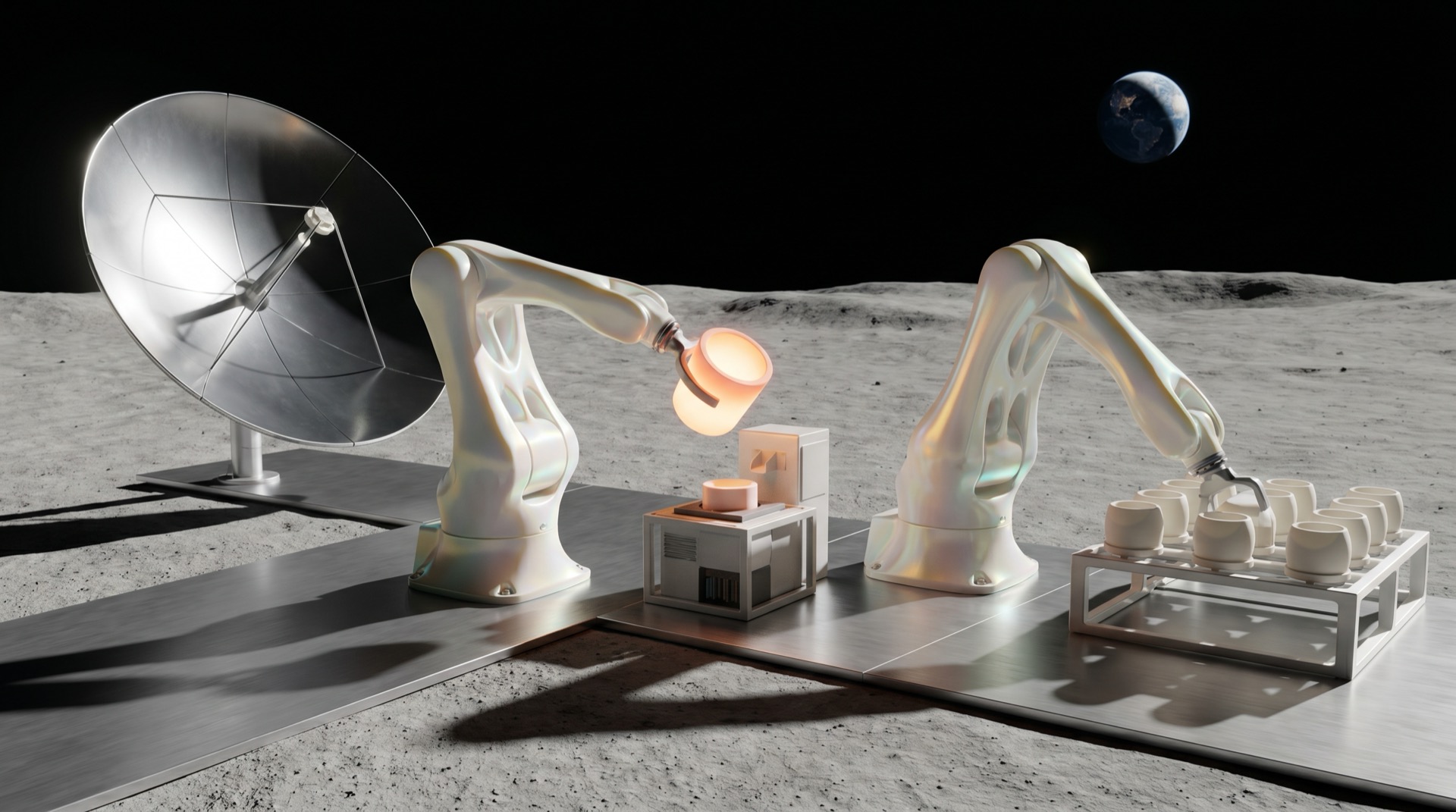
Cheaper launch makes space busier, and a busier frontier needs far more mass: propellant, structure, spares and shielding for every base, ship and depot. That bulk is the last thing worth hauling up a gravity well. Someone has to build the supply chain out there. That is the work.
- 02
A few materials, made local
So we work a material made from common oxide and a process that needs almost nothing shipped in. The discipline that makes a part affordable on Earth is the same one that makes it possible where nothing can be shipped at all.
- 03
Scale is the point
An automated cell and a simple ceramic arm make the parts, and over time more of their own parts. Launched mass stays linear, paid for by the kilogram, forever. A factory that extends itself compounds. That is how you reach the tonnages a real frontier needs, and the propellant and structure it makes send the next ship farther.
- 04
The one thing that has to work
We are honest about the hinge. Almost everything is local. The few percent that is not is the electronics, and a real factory has to make its own. The plan is to lean on simpler, proven designs a small line can actually build, shrinking even that last import. Prove it, and imports stop growing while output compounds. This is the question the whole plan turns on, and the one we answer cheaply, on Earth, first.
- 05
Earned by shipping
We do not promise dates we cannot keep. The materials, the software and the robots that work on Earth are the same ones that work out there. We earn the vision by proving it, step by step, in what we ship.
Demonstrated, next, and the direction
The goal is large. We reach it one verified step at a time: what is proven on the bench today, what we are building toward next, and the direction beyond.
Proven on the bench or converged in simulation today.
Single-crystal sapphire fibre
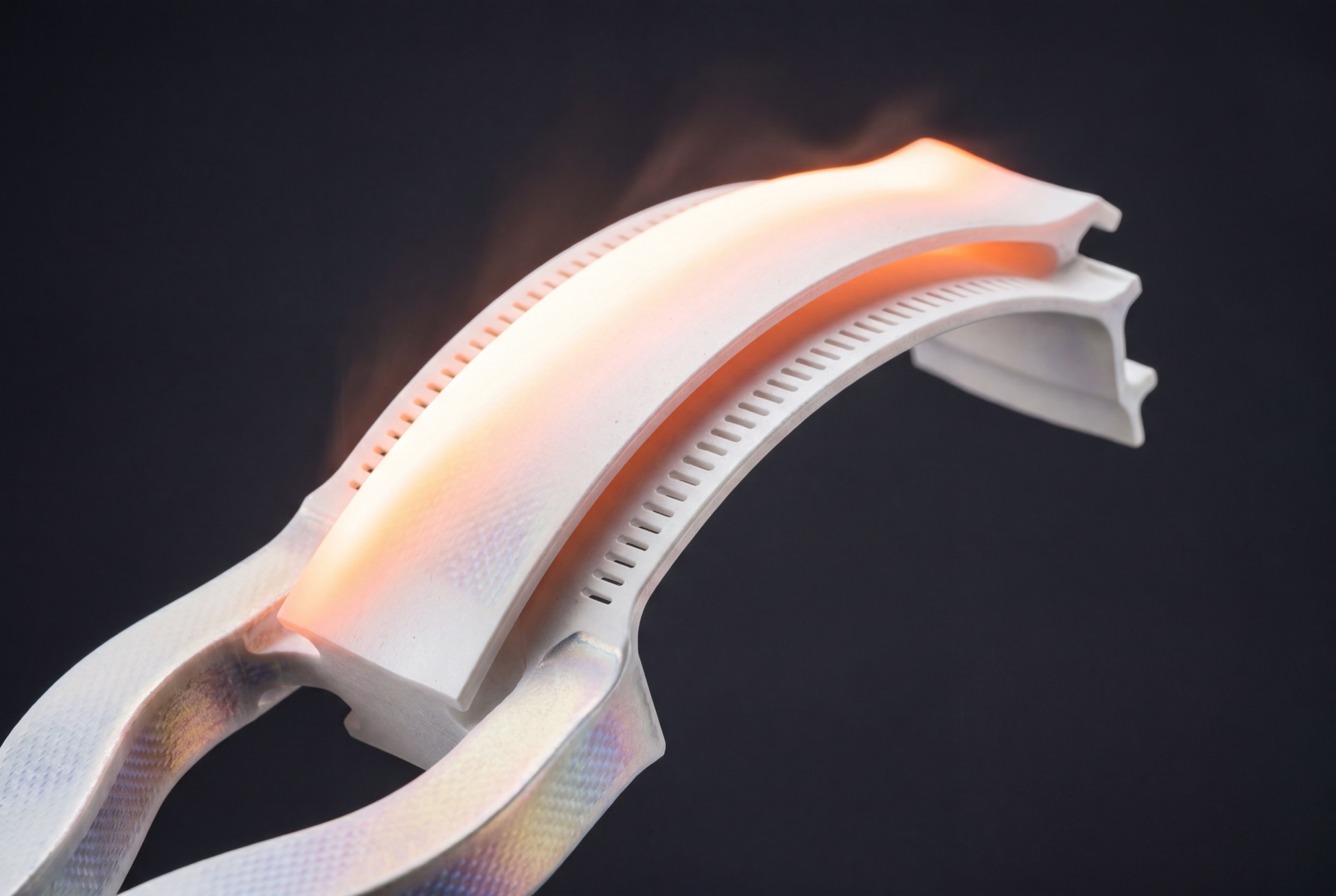
2026Fine monocrystalline-alumina filament grown on the bench. The base reinforcement, first samples in hand.
Woven oxide-composite sample
2026Sapphire-fibre fabric set in an oxide matrix into a test piece, produced and measured.
The solver designs a graded part
2026Field-to-architecture solver v1 turns a stress and thermal field into a per-point fibre recipe with sinter pre-compensation.
Destruction test vs. coated silicon-carbide
2026A SEED oxide part holds at ~1500 °C oxidising beside a coated silicon-carbide sample that flakes and fails.
Pilot fibre array
2026 H2A small crystal-bushing array grows fine single-crystal sapphire fibre in parallel, in vacuum, heated by induction without a laser. The work of an operator, automated.
The next rungs, built and measured on Earth first.
First qualified, paid part
Target 2027A semiconductor or energy customer part designed, built, qualified and shipped, client-funded.
Repeatable qualification
2027A documented design-to-finished-part loop in the first market, fast and right the first time.
The objects line
2026–2027Limited sapphire-ceramic objects: craft, proof you can hold, and a way to support the work.
A second, scaled array
2027Scale the proven process to more fibre and parts, and a wider qualification record.
Kinematic coupling proven
2026–2027The passive ceramic mount that gives micron repeatability holds over thousands of cycles, dust included. The precision the robotics rest on.
Assembly time-and-motion
2027Pre-tested modules snap together fast under realistic control latency. The cheapest test that could break the plan, run early.
The goal itself: the supply chain off-Earth.
The arm builds the arm
A milestoneA robotic arm cast from our own ceramic assembles its own parts from local-equivalent stock. The recursion behind a factory that builds more of itself.
The supply chain off-Earth
The long gamePropellant, structure and parts made from local resources as the frontier opens. The mass made there, not hauled up a gravity well. Proven on Earth first.
Earned by shipping, not promised ahead of it
The materials, the software and the robots that work on Earth are the same ones that work out there. We do not date the mission. We prove it, step by step, in what we ship.